What we do
RESTORATION
MEET DIVYA - FAMILY IS POSSIBLE
Divya, an 11 yrs old girl, lost her mother at an early age. She was rescued by police from child labor and referred to our home in Kathmandu. She was raised by her grandparents, uncle and aunt. Her father abandoned her. One day Divya was brought to Kathmandu by her step-mother but she eventually ended up in child labor, out of which the stepmother made money. Her grandmother was told that she was in a nice hostel and school. Her mother lied.
Divya was malnourished and had speech delays. She had to work beyond her capacity. It was found the delay was a result of isolation and trauma. It took a few months to recover her health. She received trauma therapy. After months of assessment, it was found she came from a remote mountain village of Nepal. During safety and family assessment it was found her extended family is fit to care for her. The reunification with grandmother is found to be in the best interest of the child.
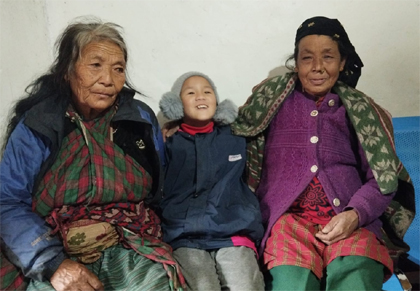
Divya's family is from a mountain region of Nepal where a bus drive was not possible. After two days of motorcycle riding, on the tough roads, she was legally reunited with her grandmother. The reunification was done along with family, local government, police and school to ensure a stronger community gate keeping.
Interestingly, as we rode higher and closer to her village, Divya started speaking better and seemed joyful. She could feel home. She ran to hug her grandmother as soon as she saw her.
We worked with the school and local government to ensure some of her incentives. Local government promised to provide orphan allowance for Rs 2000 per month and the school provided free tuition until grade 10.
It is now almost 6 months since Divya reunified into the family. She is thriving a family life with her grandparents, uncle, aunt and friends from her community.
CASE MANAGEMENT
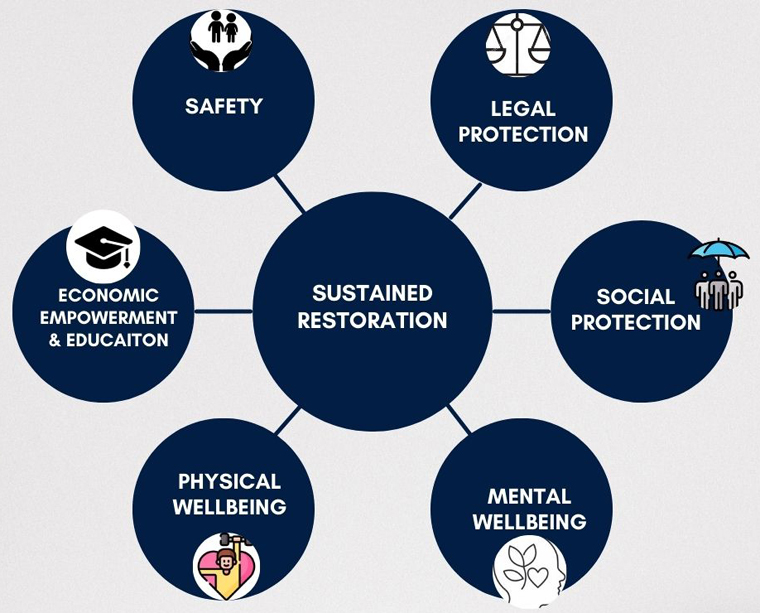
Every child is unique and comes from a specific vulnerability. The cases cannot be generalized. We follow a scientific approach to manage the case of every child. The vulnerability is identified on the basis of following six criteria (adopted from IJM Model of Assessment of Survivors Outcome). Once the specific vulnerability is identified, our social workers make care plans for each child. This amplifies the outcome of case management towards sustained restoration – meaning a child is restored in family and community with least vulnerability to revictimization.
Once the child is rescued and Bethany gets the legal guardianship, the following steps are undertaken towards restoration.
A key to Care Plan
A team of 6 social and case worker meets every week to discuss on the care plan. “A common struggle is to set the right goal because if we set the wrong goal, we deliver wrong interventions that negatively impacts the restoration of the child”, says Case Manager. However, Assessment of Survivors Outcome has been a game-chager to set the right goal for the survivor. The IJM best practice ASO, assesses the vulnerability of survivor based on 6 different domains. Each domain, with supporting indicators, rates from 1 to 4 (high risk to stability). The domain with the high risk is then translated into the goal for the care plan, which ultimately have several intervention activities towards stability.